The Scottish Highland Games
Highland Games are one of Scotland’s great sporting traditions which are held in spring and summer (May and September) in Scotland, across the country. It’s a colourful story of sports, culture and community, a celebration of the heritage and history of Scotland and the Scottish Highlands, where the clans would compete against each other in feats of strength and skill.
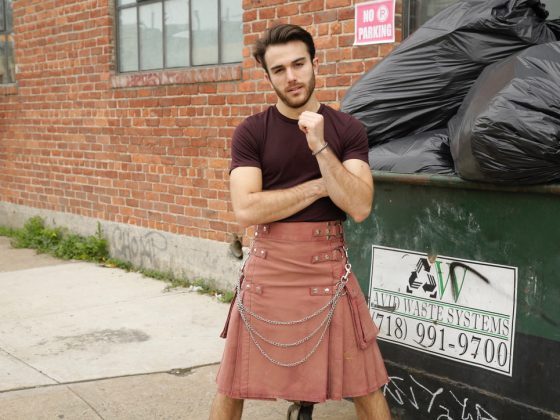
If you are heading to the games as a competitor or a spectator, our guide to kilts for Highland games explains what to wear, and the 5 yard casual kilt is the one most people choose for a long day on the field.
Even though the Scottish Highland Games originated in Scotland, it does not mean the events are open strictly to those of Scottish heritage. This means that anyone can enjoy them, even the non-athletic types since there are other competitions such as dancing and bagpipe playing. Events that comprise of a blend of sports and culture.
What games are in the Scottish Highland Games?
There are more than 60 games in Highland Games Sports, in which some of them are:
- Dancing
- Braemar Gathering
- Caber toss
- Throwing the hammer
- Tug o’ War Shinty
- The Ba’ Game
- Stone Skimming
- Shot Put
Highland Dancing
Highlands Dancing takes place during these events, and it requires a great deal of skill, the endurance, stamina, and strength of an athlete and the artistry of a dancer. It’s the most sophisticated forms of national dancing in the world.
Braemar Gathering
This amazing event Braemar Gathering takes place on the first Saturday of September every year. It is the most famous and best-attended Highland Games in Scotland and features which features Heavy Events like tossing the caber, throwing the hammer & Famous tug o’ war.
Caber Toss
The Caber Toss is perhaps the most famous of these games. It is a show of strength where participants launch a massive, heavy wooden post with the goal not of sending it the furthest but by lining it up at the right angle.
Throwing the Hammer
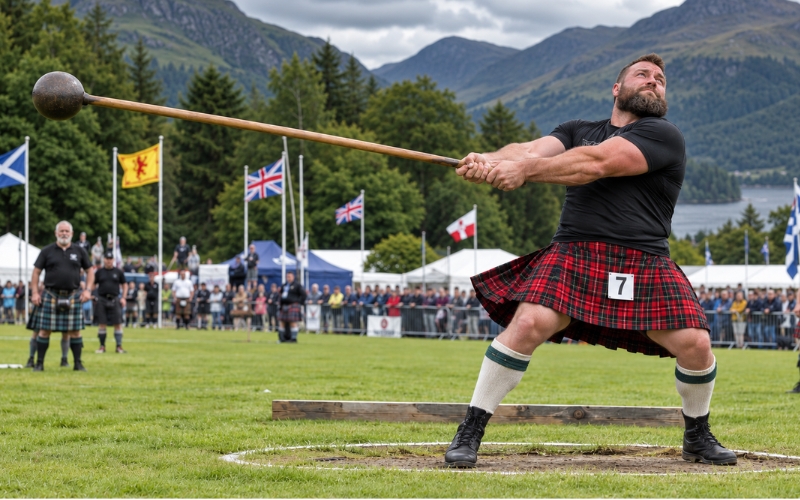
Hammer Throwing is a game in which participants use the hammer which is hurled for distance, and then throw it using two hands within a circle. It’s made from a metal ball which weighs around 22lb to 15lb vary from Men to women which are attached to a wooden handle.
Tug o’ War
So, Tug o’ War is the most interesting, classic summer camp game, in which two players or teams battle to prove their strength by tugging harder than their opponents on a rope. It’s a good addition to the event because as you know “the louder you cheer, the stronger your pull on the rope will be!”
Shinty
Shinty is a team sport that, more than most other events, requires a solid, well-planned effort by all members of the teams to succeed. Since shinty is a sport that has been played for many generations in the Highlands, it is one that many pay close attention to during the events. It is a rough and tumbles sport that is actually thought to come from warriors who trained in battle and is not for those who are faint of heart.
The Ba’ Game
Similar to football, Ba’ is a football game that is played on the streets and is typically observed on New Year’s Day, Christmas Day and most other festive seasons. It is played throughout the entire town, and in Orkney, it starts on Broad Street with the goal post on the other side of town. The first team that is able to touch down at the goal on the opposite side using the ba’ wins the game.
Stone Skimming
Though it is played by children at lakes, stone skimming is actually a wildly loved and highly anticipated event at any Highland games. It requires a combination of aim, precision, and skill, and there is even a World Stone Skimming Championship each year on Easdale Island. This game can be practiced on any body of water at any time, giving you plenty of time to get ready before entering the competition.
Shot Put
Want to exercise your throwing power with a heavy object? Then, Shot Put is a sport where an athlete plays with a heavy spherical object known as shot. It’s a track and field event which requires immense muscular strength and a good balance upon your body.
STILL HAVE QUESTIONS?
Team Scottish Kilt Shop is always willing to help customer to make their Highland Games more valuable and memorable, therefore you can ask for any customization or requirements, like Buttons, tartan patterns, big & tall kilts or anything comes into your mind.
You will find us ready to make your event Special!
Contact Help Center for more information:
Frequently Asked Questions
What should you wear to the Highland games?
For spectators, ordinary outdoor clothing and waterproofs; the games are held outdoors in Scottish weather. Many attendees wear a kilt, and a casual or 5-yard kilt with a plain shirt and boots is more practical than a full formal outfit. Competitors in the heavy events wear a kilt, a shirt and heavy boots, and dancers wear the outfits set by their dancing board.
When are the Highland games held?
The season runs roughly from May to September, with events staged across Scotland most summer weekends. The Braemar Gathering, the best known of them, takes place on the first Saturday of September and is traditionally attended by members of the Royal family. Games are also held throughout the year by Scottish communities in North America, Australia and New Zealand.
How is the caber toss scored?
Not by distance. The thrower runs with the caber upright and flips it end over end, and the judge scores the direction it falls in, read like a clock face from where the thrower stands. A perfect toss lands at twelve o’clock, straight away from the thrower. If nobody turns the caber, the judge scores the highest angle reached instead.
What are the heavy events?
The strength disciplines at the centre of the games: the caber toss, the Scottish hammer throw, the stone put, the weight for distance, the weight over the bar and the sheaf toss. The hammer is thrown from a standing position without turning, which is what separates it from the Olympic event, and is typically 22lb for the heavy and 16lb for the light.
Do you have to be Scottish to compete?
No. Open competitions at most games accept entries from anyone, and the heavy events in particular draw international athletes. Some clan or local events have their own eligibility rules, and Highland dancing is governed by registered boards with their own grading. If you want to compete, check the entry conditions for that specific gathering.