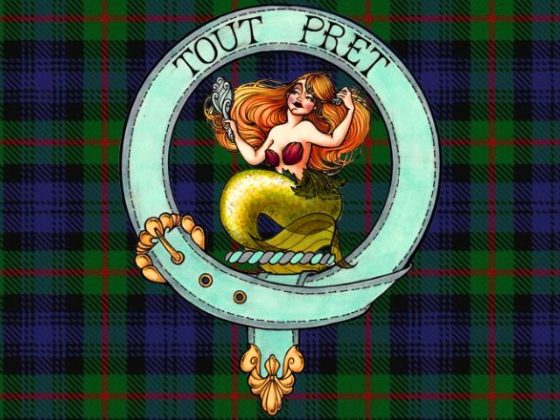
A Tale of Unyielding Fortitude & Dynasty!
Clan Territory:
The Scottish Borders, centred on Liddesdale, with lands in Eskdale and Annandale. The Armstrongs were a Border family, not a Highland clan.
Clan Motto:
Encapsulated in the phrase Invictus Maneo, resounds with resilience. This motto, meaning “I remain unvanquished,” echoes our commitment to unwavering determination.
Challenges falter, but our spirit stands strong. Invictus Maneo: a reminder that we endure, undefeated.
Clan Chief:
The final leader of the Armstrong Clan, Archibald Armstrong of Mangerton, met his end circa 1610 through the hangman’s noose. His demise was a consequence of spearheading a daring cattle raid upon Penrith.
Clan Armstrong has had no chief since then and is classed as an armigerous clan. That does not stop Armstrongs wearing the crest badge and tartan in their own right.
Armstrong Crest & Coat Of Arms:
The Armstrong crest is recorded as an arm from the shoulder, armed, Proper. In plain language, an armoured arm, a visual pun on the family name. Clan members wear it as a crest badge inside a strap and buckle bearing the motto Invictus maneo. A full coat of arms, the shield and its supporters, belongs only to a person who holds a grant of arms, and because the clan has had no chief since 1610 there is no chief’s coat of arms in current use. The crest and motto are recorded in the Clan Armstrong entry on Wikipedia.
Clan Castle:
On the west bank of the River Esk near Canonbie stands Gilnockie Tower, also known as Hollows Tower, built around 1518 and associated with Johnnie Armstrong of Gilnockie, the most famous of the Armstrong reivers. It survived English raids and centuries of neglect, was restored from a roofless shell in the late 20th century, and now houses the Clan Armstrong Centre.

The Armstrong Clan Origin:
The Armstrong Clan, originating from the borderlands of Northumbria and the Scottish Borders, holds a storied history. With its roots in Scotland and northern England, the name ‘Armstrong’ draws from Old English, possibly meaning ‘son of strength.’ This clan, renowned for battle prowess, played a significant role in the Anglo-Scottish conflicts of the Middle Ages. Siward Beorn, an Anglo-Danish Earl, is considered the first Armstrong, while legends recount tales of exceptional strength displayed by figures like Fairbairn.
Supporting Robert the Bruce and contributing to historical events, the Armstrongs left an indelible mark. Notably, Sir Adam Armstrong defended the Scottish border, and Gilbert Armstrong served as an envoy. This clan’s enduring legacy is tied to its strength, history of conflict, and association with the border region. Through prominent figures like Chief Will Armstrong, their compelling story endures, capturing the essence of Scottish history and the borderers’ spirit.
Sourced From “armstrongclan.info”
Clan Armstrong History & Border Reiver?

Discover the captivating saga of Clan Armstrong, a prominent border clan rooted in history. Originating from Cumberland, just south of the Scotland-England frontier established in 1237, the Armstrongs wield a rich heritage. Legend has it that their heroic progenitor, Fairbairn, earned them the illustrious Armstrong name and crest by saving the Scottish king in battle. Over time, their influence expanded from Liddesdale, their family seat, to Annandale and Eskdale by 1528. While their relationship with Scottish kings proved tumultuous—marked by the execution of John Armstrong by King
James V in 1530—1587 saw the Scottish parliament underscore their significance. However, by 1610, the Armstrongs’ sway receded, yielding their lands to the Scotts. Renowned for their reiver activities, they clashed even with King James V himself. This is a tale woven with intrigue, courage, and a touch of enigma, forever imprinted upon the Armstrong crest, coat of arms, and the annals of history.
AND THE BORDER REIVER:
Explore Clan Armstrong’s storied past and the captivating realm of Border Reivers. Originating from the late 13th to early 17th century, these figures thrived amid the Anglo-Scottish Border’s conflicts. The term “Reiver,” rooted in Old English’s “rēafian,” defined their plundering ways. Families like the Armstrongs erected protective “peel towers,” emblematic of loyalty. The Armstrongs, among the most feared Scottish clans, left an indelible mark, epitomized by the imposing 1520 Gilnockie Tower.
The 1603 Union of the Crowns marked their decline, fortified houses falling in 7

years. Armstrongs faced grim fates, their chief hanged in 1610. Yet, the Border Reiver spirit lives on in the borderlands’ cultural fabric. “Reiving” ensured survival in shifting jurisdictions, while romanticized ballads concealed harsh realities. In 3 centuries, Clan Armstrong left an enduring legacy intertwined with Scottish royalty, evoking fear and respect.
Notable Armstrongs Around The World!
Discover the captivating saga of the Armstrong clan in our feature on ‘Notable Armstrongs Around The World!’ Rooted in qualities of bravery, independence, and strength, the Armstrongs persevered through trials, retaining their spirit even after being uprooted from their lands and Chieftain. From Border Reivers to global pioneers, these traits propelled them to success. Records echo the clan’s footprint in history – from the Netherlands to Virginia by 1623. Barbados welcomed Stephen, Edward, and Mary Armstrong, heralding the spread of their lineage.
As they ventured to lands like Ireland, Canada, USA, Australia, and New Zealand, their story thrived, nurturing vibrant generations. Noteworthy is Neil Alden Armstrong, Ohio-born in 1930, etching his name as the first moonwalker in 1969, a testament to his Clan’s legacy. He paid homage, returning to Scotland in 1974, hailed a Freeman, and gracing Gilnockie Tower. Unveil the tapestry of Armstrong history, where bravery knows no bounds, echoing through time.
Armstrong Tartan:
Step into the world of Scottish heritage with the captivating Armstrong Tartan. This striking tartan, hallmarked by its dominant green and navy hues, comes alive with bold red stripes accompanied by sleek black lines. Its roots trace back to the 19th century, specifically to 1842, when its captivating design was meticulously detailed in the Vestiarium Scoticum by the Sobieski Stewarts.


The Armstrong Tartan stands as a symbol of clan pride, with its distinct tartan pitch pattern representing the renowned Armstrong clan. For those seeking to embody the spirit of their heritage, the Armstrong Tartan Kilt fabric is a tangible piece of history. From traditional kilts to modern accessories, the Armstrong Tartan remains a timeless emblem of the rich Scottish culture carried by the Clan Armstrong.
The Armstrong tartan is woven in Ancient, Modern and Weathered colourways. See all of them, made to order as kilts, jackets, skirts, scarves and fabric by the yard, in our Armstrong tartan collection.
Frequently Asked Questions
What clan does Armstrong belong to?
Armstrong is itself a clan name. Clan Armstrong is a Border clan from Liddesdale in the Scottish Borders, with lands that once stretched into Eskdale and Annandale. It has had no chief since 1610 and is classed as an armigerous clan, but Armstrongs wear the Armstrong crest badge and tartan in their own right.
What area of Scotland is the Armstrong Clan from?
The Armstrong Clan originates from the Borders region of Scotland, which includes areas like Dumfriesshire and Roxburghshire.
Is Armstrong Scottish or Irish?
The Armstrong Clan is Scottish in origin, specifically from the Borders region of Scotland.
Is the Armstrong name Viking?
While there is some historical connection to Norse influences, the Armstrong name is primarily associated with the Scottish Borders, not Viking origin.
How old is the Armstrong Clan?
The Armstrong Clan’s history dates back to medieval times, likely tracing its origins to around the 13th to 14th centuries.
Is there an Armstrong Castle?
Yes, there is a notable Armstrong stronghold known as Gilnockie Tower, which is often referred to as the Armstrong Clan Castle. It is located near the village of Canonbie in Dumfriesshire, Scotland.
Is there an Armstrong tartan?
Yes. The Armstrong tartan, first published in the Vestiarium Scoticum of 1842, is a green and navy sett with red and black lines. It is woven in Ancient, Modern and Weathered colourways and made to order as kilts, jackets, skirts, scarves and fabric by the yard in our Armstrong tartan page. Neil Armstrong famously carried a piece of it to the Moon in 1969.